Craftdot
Christmas Scavenger Hunt Clue Cards: Free Printable, Write Your Own Clues
Printable Christmas scavenger hunt clue cards with blank ruled lines, so every clue fits your own house. Letter and A4. Free, no signup.
No email or signup. Printing instructions are below.
On this page
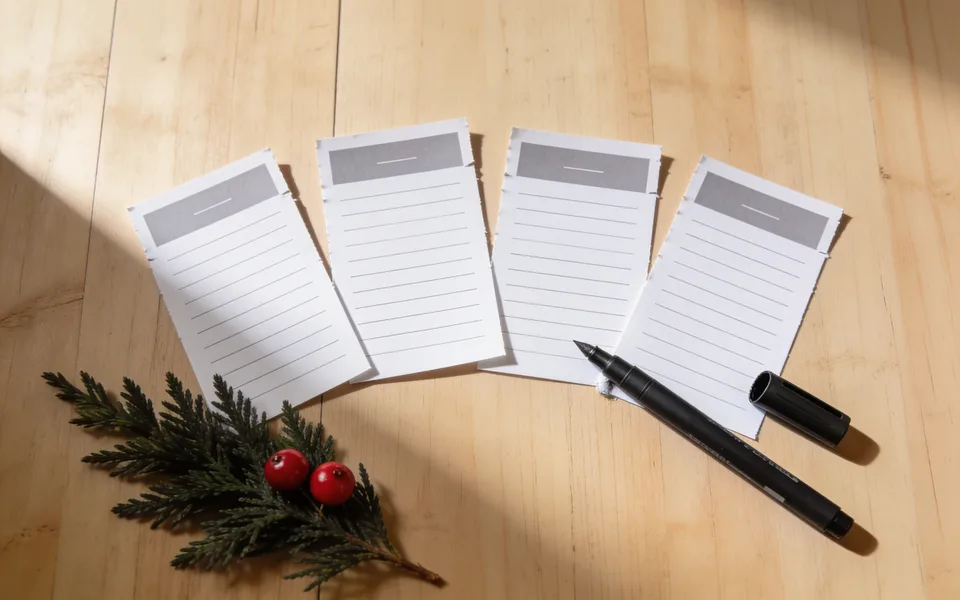
These are blank clue cards for a Christmas scavenger hunt. Print them, cut them apart, and write the clues yourself, because the hiding places are in your house and nobody else's.
Download: Christmas scavenger hunt clue cards, free PDF, Letter + A4. No signup, no email.
A scavenger hunt printable that arrives with the clues already written in sounds like less work until you read them. "Check the oven" is no use if your oven is the one place nobody is allowed to look, and a written-in clue can point at a fireplace or a basement or a dog bowl you do not have. A clue generator has the same trouble. It can write a lovely clue for a house it has never been inside. So the writing is left to you here, and the part we can actually help with is the bit most people get stuck on, which is what a clue has to sound like before a small child can solve it.
What is in the file
Four pages. Pages 1 and 2 are US Letter, pages 3 and 4 are the same cards on A4, so you only print the pair that matches your paper. Each page holds four cards, numbered Clue 1 through Clue 8 across the two sheets.
Every card has a dashed line right around it to cut on, its number at the top, and five ruled lines to write on. Those lines are set wide deliberately: about 20mm apart on the Letter pages and about 22mm on A4, near enough three quarters of an inch either way. A chisel-tip marker sits on them without the letters running together, and so does ordinary handwriting done in a hurry late at night.
Three kinds of clue that work on a six-year-old
You do not need eight clever clues. You need one or two shapes you can repeat, and these three cover almost any house.
Ask them about their own day
A six-year-old often reads slowly, but they know their own routines by heart. A question about something they do every day more or less answers itself, and they get to feel clever instead of tested.
- Where do your shoes go when you come inside? Look there.
- Where does your toothbrush live? Go and see.
Three little hints, the easiest one last
Three short sentences are kinder than one long one, and a child can shout the answer after any of them, so the same card works for a confident reader and a stuck one. Put the strange hint first and the dead giveaway last, so it always ends with them getting it.
- I hum. I am cold inside. The milk lives in me.
- I am soft. I stay on your bed. Your head sleeps on me.
Tell them how to travel
At six, most of the fun is in the moving rather than the puzzling. A plain destination with a silly way of getting there beats a clever riddle, and it is very easy to write when you are tired.
- Hop like a bunny to the place where we eat dinner.
- Tiptoe, quiet as a mouse, to the front door.
The thing that goes wrong is rhyme
Do not rhyme. Nearly every pre-written set does, so it feels like the proper way to do it, and then you catch yourself writing "in the place where boots do stay, your next clue hides away". No six-year-old talks like that, so no six-year-old understands it.
To make a rhyme land you end up bending the sentence backwards and reaching for words you would never say out loud, and the child hears a little song instead of an instruction and looks up waiting for you to translate it. Write the clue the way you would say it across the kitchen. If it happens to rhyme, lovely, but a plain clue they solve beats a rhyming one you have to explain.
Two smaller traps worth knowing. A clue with a "not" in it tends to backfire, because they hear "not the couch" and head straight for the couch, which is the picture the sentence just put in their head. And two instructions on one card usually lose the second one by the time they are moving. Keep it to one thing per card.
Hiding them so the hunt does not fall apart
Write all the clues before you hide anything, then hide everything backwards. The words on each card have to point at the spot where the next card is sitting, and it is genuinely easy to end up one card out of step.
Hide the prize first, then the last card in the spot the one before it names, working back down the line until the first card is in your hand, and that is the one you give them.
Tuck each card properly out of sight. A child who trips over clue six while hunting for clue two will happily take the shortcut, and the middle of your hunt vanishes. If they get stuck, do not read the clue again louder. Say warmer and colder and drift the right way with them. A six-year-old has about thirty seconds of stuck in them before they stop playing altogether.
Print it twice
Print the file a second time and keep the spare in your pocket. On that copy, write down where you hid each real card instead of the clue. It fixes both of the ways this goes wrong at once, the clue that points one card out of step, and the hiding place you were completely sure you would remember. The file is free, so an answer key costs you a sheet of paper.
If you are running it for two children, give one of them the odd numbers and the other the even ones. The cards settle whose turn it is before anybody has to argue about it.
For another activity to fill in together, try the New Year time capsule with prompt cards for kids and grown-ups.
Common questions
Are the clues already written on the cards?
No, and that is deliberate. The cards carry numbered headings and wide ruled lines, and you write the clues yourself. Pre-written clues send children to a fireplace or a porch swing you may not have. Blank lines take two minutes to fill in and every clue then fits your own rooms.
How many cards are in the file?
Eight numbered cards. The lines are ruled wide enough for a marker rather than a fine pen, so an adult writing quickly still produces something a child can read across a room.
Does it print properly on A4?
Yes. The file holds two US Letter pages and two A4 pages. Print the one that matches your paper and choose Actual Size rather than Fit to Page, which shrinks the cards and the ruled lines with them.